LASIK in Turkey: Femto-LASIK Cost & Partner Surgeons in Istanbul
LASIK surgery in Turkey with independent, experienced refractive surgeons in Istanbul, from €1,500 for both eyes all-inclusive. Femtosecond flap technology, a 3-4 night trip, and honest candidacy screening. Your surgeon makes every clinical decision; Luna coordinates the journey.
 Written by Kubilay Aydeğer

An ophthalmologist and eye surgeon with 25+ years of experience, a graduate of Istanbul University Cerrahpaşa Faculty of Medicine (1995) who completed his ophthalmology specialty in 2001, with a clinical focus on laser refractive and cataract surgery. An independent partner surgeon; he reviews this page for medical accuracy and does not guarantee individual results.
Last reviewed
An independent partner specialist who may treat patients Luna introduces.
LASIK in Turkey is the most requested form of laser vision correction for international patients: a 15-30 minute procedure for both eyes that corrects myopia, hyperopia and astigmatism, with most people seeing clearly within 24-48 hours. In Istanbul, LASIK surgery costs from €1,500 for both eyes as an all-inclusive package, compared with £1,700-£3,000 per eye at clinics in the UK, or €2,000-€3,500 per eye in Ireland and Germany.
Turkey welcomed over 700,000 medical tourists in 2023, and refractive surgery is one of the specialties behind that volume: Istanbul’s eye surgeons perform LASIK daily on high-volume laser platforms. Luna Clinic Medical Travel Services is a medical travel coordination company based in Istanbul. We are not a clinic: we introduce you to independent partner ophthalmologists who perform LASIK at their own accredited facilities, including JCI-accredited hospitals in Istanbul.
A bilingual Luna coordinator arranges your flights guidance, hotel, transfers and interpretation around a compact 3-4 night schedule, while every clinical decision, from whether your corneas can safely support a flap to the exact treatment profile programmed into the laser, is made independently by your partner surgeon after a full diagnostic work-up. Luna does not perform surgery and does not guarantee outcomes.
Cost comparison: Turkey vs the UK
| Location | Typical price | What is included |
|---|---|---|
| Turkey (Istanbul, Luna partner surgeons) | from €1,500 both eyes | Procedure, hotel, transfers, interpreter |
| United Kingdom | £1,700-£3,000 per eye | Procedure only |
Indicative prices, last checked in July 2026. Turkey figures are starting prices quoted in euro by independent partner surgeons and cover the items listed. UK figures are typical private prices in pounds sterling and are shown for comparison only. Your surgeon sets the final price after assessment.
Compare 50 procedures in the Turkey Treatment Cost Report 2026
How much does LASIK surgery in Turkey cost?
LASIK cost in Turkey typically ranges from €1,500 to €2,200 for both eyes, with femto-LASIK (bladeless, all-laser) at the upper end of that range. In the UK the same procedure is routinely quoted at £1,700-£3,000 per eye, and at €2,000-€3,500 per eye in much of Western Europe, which is why many patients find the total cost of a LASIK trip to Istanbul, flights and hotel included, lower than treating a single eye at home.
As with every treatment Luna coordinates, the partner surgeon’s medical fee and the travel coordination fee are presented side by side. The final LASIK price for your eyes depends on:
- Flap technology. Femto-LASIK creates the flap with a femtosecond laser rather than a mechanical microkeratome blade; the added precision comes with a higher platform cost.
- Treatment profile. Wavefront-optimised or topography-guided ablation profiles for irregular corneas or larger pupils can affect the fee.
- Your prescription. Higher corrections and significant astigmatism require longer, more complex ablations and stricter candidacy checks.
- Surgeon and facility. Experienced high-volume refractive surgeons at accredited eye hospitals typically charge more than budget providers.
LASIK in Istanbul: the all-inclusive package
Most international patients book LASIK in Istanbul as a fixed-price package around a 3-4 night stay. A typical Luna-coordinated LASIK trip includes:
- Comprehensive diagnostic examination (topography, pachymetry, refraction, dry-eye check) with the partner surgeon
- Femto-LASIK or LASIK treatment for both eyes at the surgeon’s accredited facility
- Next-day post-operative check-up and travel clearance
- All prescribed antibiotic and lubricating eye drops, plus protective shields
- VIP airport, hotel and clinic transfers throughout your stay
- 4-5 star hotel accommodation (typically 3-4 nights)
- Dedicated bilingual patient coordinator throughout your stay
- Structured remote check-ins coordinated with your partner surgeon after you return home
Package pricing starts from €1,500 for both eyes with full cost transparency. Your surgeon provides the final quote after your diagnostic examination, and if testing shows LASIK is not safe for your corneas, surgery does not go ahead; your surgeon will discuss alternatives such as PRK, SMILE or lens-based options.
How femto-LASIK works, step by step
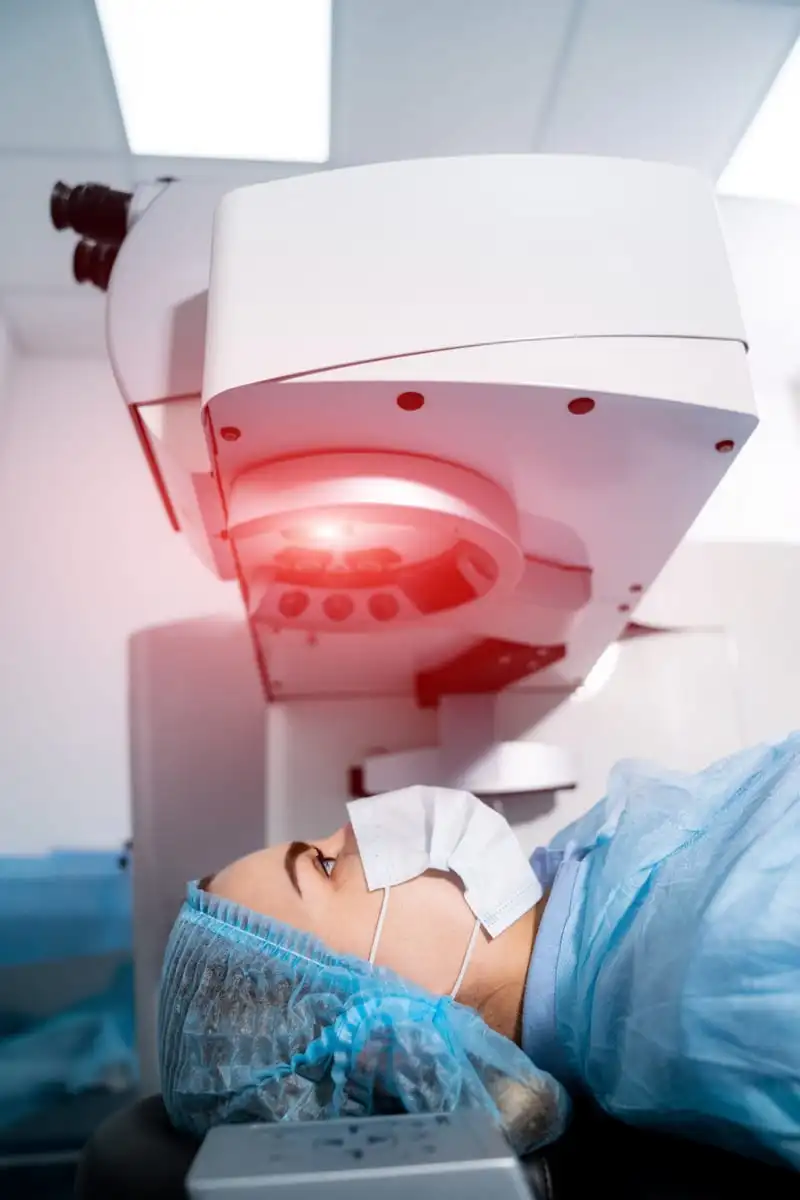
Modern LASIK in Istanbul is usually femto-LASIK: an all-laser, bladeless procedure. Understanding the steps takes most of the fear out of it:
- 1. Numbing and positioning
- Anaesthetic drops numb each eye; no injections and no general anaesthesia. You lie under the laser and a small holder keeps the eyelids gently open.
- 2. Flap creation (seconds)
- A femtosecond laser creates a thin, hinged flap in the outer cornea in around 10-20 seconds per eye. You feel light pressure and vision dims briefly.
- 3. Reshaping the cornea
- The surgeon lifts the flap and an excimer laser reshapes the corneal tissue to your exact prescription, guided by an eye tracker that follows micro-movements hundreds of times per second.
- 4. Flap repositioning
- The flap is laid back into position, where it adheres naturally within minutes and continues sealing over the following hours. No stitches are needed.
- 5. Rest and next-day check
- You rest at the hotel with shields over your eyes. At the next-day check-up your surgeon confirms the flaps are settled and vision is already sharp for most patients.
LASIK vs PRK vs ReLEx SMILE
LASIK is one of three established laser techniques, and your surgeon may recommend a different one after examining your corneas:
- LASIK: fastest recovery
- Clear vision typically within 24-48 hours and minimal discomfort. Treats myopia up to about -8 to -10 dioptres, hyperopia up to about +4 and astigmatism up to about 5-6, subject to corneal thickness. The flap requires adequate corneal tissue.
- PRK/LASEK: no flap, slower healing
- The laser treats the corneal surface directly, preserving more tissue, so it suits thinner corneas and people at risk of eye trauma (boxing, martial arts). Expect a few days of discomfort and vision that sharpens over weeks rather than days.
- ReLEx SMILE: keyhole and flapless
- A lenticule is removed through a 2-4 mm incision, with less disruption of corneal nerves and a lower reported rate of dry eye. Only treats myopia and myopic astigmatism, and costs slightly more.
Am I a candidate for LASIK?
Candidacy is a clinical decision that only your partner ophthalmologist can make after measuring your eyes, which is why every trip begins with diagnostics rather than surgery. As a general guide, good LASIK candidates are 18 or older (many surgeons prefer 20+), have had a stable prescription for at least 12 months, and have sufficient corneal thickness, typically around 500 microns or more, with a healthy corneal shape on topography.
LASIK is generally ruled out by keratoconus or other corneal disease, severe dry eye, uncontrolled diabetes or autoimmune disease affecting healing, and pregnancy or breastfeeding, which can temporarily change your prescription. If you wear contacts, you pause soft lenses for about a week (longer for rigid lenses) before testing so your corneas return to their natural shape. Being ruled out for LASIK does not end the road: PRK, SMILE, ICL or refractive lens exchange may still be options your surgeon can discuss.
LASIK recovery timeline
LASIK has the fastest recovery of the laser techniques. Your surgeon sets your individual plan; a typical course looks like this:
- First hoursGrittiness, watering and light sensitivity for 4-6 hours; you rest at the hotel with protective shields. Vision is already usable but slightly hazy.
- Day 1Next-day check-up with your surgeon. Most patients see 20/40 or better, many already close to 20/20, and can shower carefully and use screens in moderation.
- 2-3 daysCleared to fly home in most cases after the check-up. Office work and daily activities resume; you continue antibiotic and lubricating drops.
- 1-4 weeksVision stabilises and night glare or halos begin to fade. No swimming, saunas, eye rubbing or eye make-up until your surgeon clears them.
- 3 monthsThe cornea is fully settled and your final result is assessed. Dry-eye symptoms have usually resolved; any rare residual prescription is discussed at this point.
LASIK in Turkey: results, success rates and risks
LASIK has decades of published outcome data. Peer-reviewed studies generally report that 96-99% of well-selected patients achieve 20/40 vision or better without glasses, with over 90% of low to moderate myopes reaching 20/20, and satisfaction rates above 95%. Those figures reflect careful candidate selection, which is exactly why the diagnostic examination matters more than the laser brand.
Risks are uncommon but real: temporary dry eye is the most frequent, night-time glare and halos usually fade over weeks to months, and a small percentage of patients need an enhancement to fine-tune the result. Flap-related complications are rare with femtosecond technology but are the reason LASIK requires adequate corneal thickness. Your partner surgeon reviews your personal risk profile with you before you commit, and no outcome is ever guaranteed.
Why patients choose Luna Clinic Medical Travel
Verifiable partner surgeons
We only introduce patients to surgeons whose board certification and society memberships can be independently verified.
Clinical decisions stay with your surgeon
Suitability, technique, the procedure and clinical aftercare are handled by your partner surgeon at their own accredited facility.
One coordinator, start to home
A bilingual Luna coordinator handles flight guidance, accommodation, transfers, interpretation and communication with your surgeon.
Transparent, separate quotes
Your surgeon quotes the medical fee; Luna quotes travel coordination separately. You see both side by side, with no hidden costs.
What to expect on your journey
From your first assessment in Istanbul to recovery back home. Clinical steps are carried out by your independent partner surgeon; Luna coordinates the travel around them.
-
Consultation & assessment
Your independent partner surgeon reviews your goals, health and anatomy and confirms whether the treatment is right for you.
-
Personalised treatment plan
Technique, timing and what to expect are planned around your case, with a clear, itemised quote before you travel.
-
Your procedure in Istanbul
Luna coordinates transfers, accommodation and interpretation; your surgeon carries out the treatment at their accredited facility.
-
Recovery & follow-up at home
You return home with a clear recovery plan; Luna keeps you connected to your surgeon for follow-up communication.
Reviewing before-and-after results is an important step when choosing a surgeon. Where available, before-and-after images are sourced from the partner surgeon’s own practice, shown as examples only, and do not guarantee a similar result for your case.
Get a personalised quote
Tell us your goals and we will introduce you to the right independent partner surgeon in Istanbul, then coordinate every step.
- No obligation, free of charge
- Reply from a bilingual patient coordinator
- Clear, itemised quote before you travel
Thank you, your enquiry is on its way.
A bilingual Luna patient coordinator will get back to you shortly. We coordinate your travel; your independent partner surgeon makes every clinical decision.
Frequently Asked Questions
How much does LASIK cost in Turkey?
LASIK in Turkey starts from €1,500 for both eyes through Luna Clinic Medical Travel Services, coordinated with independent partner ophthalmologists in Istanbul. All-inclusive packages typically range from €1,500 to €2,200 for both eyes including the diagnostic examination, femto-LASIK treatment, hotel, VIP transfers and aftercare drops. The same surgery is commonly quoted at £1,700-£3,000 per eye in the UK and €2,000-€3,500 per eye in Ireland and Germany.
Is LASIK in Turkey safe?
LASIK is performed daily in Istanbul by experienced refractive surgeons on modern femtosecond and excimer platforms, at accredited facilities including JCI-accredited hospitals. Published complication rates are low, but risks exist, including dry eye, night glare, under- or over-correction and rare flap complications. Luna only introduces patients to independent partner surgeons whose credentials can be verified, and your surgeon explains your personal risks after examining your corneas.
How long do I need to stay in Istanbul for LASIK?
Typically 3-4 nights. Your diagnostic examination is done on arrival day or the following morning, both eyes are treated the next day in a session of 15-30 minutes, and your surgeon sees you the day after surgery for a check-up before clearing you to travel. Luna arranges your hotel and transfers around this schedule.
Does LASIK hurt?
No. The eyes are numbed with anaesthetic drops, so during the procedure you feel only light pressure for a few seconds while the flap is created. Afterwards most patients describe 4-6 hours of grittiness, burning and watering, managed with rest and lubricating drops. By the next morning discomfort has usually gone and vision is dramatically clearer.
Can I fly home after LASIK?
Yes, typically 2-3 days after surgery, once your next-day check-up confirms the flaps are settled and healing is normal. Flying itself does not harm the treated cornea, but cabin air is dry, so use lubricating drops frequently during the flight. Your partner surgeon gives the final travel clearance.
What is the difference between LASIK and femto-LASIK?
In standard LASIK the corneal flap is created with a mechanical microkeratome blade; in femto-LASIK (bladeless or all-laser LASIK) a femtosecond laser creates the flap with computer-controlled precision. The reshaping step with the excimer laser is the same. Most partner surgeons in Istanbul work with femtosecond platforms, and your surgeon will confirm which method suits your corneas.
What does Luna organise for a LASIK trip to Istanbul?
Luna coordinates the travel side: flight guidance, 4-5 star hotel accommodation, VIP airport and clinic transfers, interpretation at your appointments, and communication with your independent partner surgeon before, during and after the trip. The examination, surgery and clinical aftercare are provided and quoted directly by your surgeon; Luna presents the medical fee and travel fee side by side with no hidden costs.