Limb Lengthening Surgery in Turkey: Cost & Partner Surgeons in Istanbul
Cosmetic and medical limb lengthening in Turkey with independent, specialist partner surgeons in Istanbul, from €24,000. Every clinical decision is made by your surgeon; Luna coordinates flights, accommodation, transfers and long-term follow-up around your case.
 Written by Sedef Özdemir

An Orthopedics and Traumatology specialist with expertise in limb lengthening, arthroplasty (knee and hip replacement), hand and sports surgery, and pediatric orthopedics, trained at İnönü University Faculty of Medicine and practising at Istanbul Surgical Hospital. An independent partner surgeon; he reviews this page for medical accuracy and does not guarantee individual outcomes.
Last reviewed
An independent partner specialist who may treat patients Luna introduces.
Limb lengthening surgery in Turkey is an advanced orthopedic procedure that gradually increases the length of the leg bones, offering a solution for people who want to increase their height or correct a limb-length discrepancy. Sometimes called height surgery, it is one of the most specialised procedures in orthopedics, and Istanbul has become a leading destination for it because experienced surgeons here use the same internationally certified PRECICE and Ilizarov systems found in the UK and Western Europe, at a fraction of the cost.
Medical studies show that limb lengthening can add roughly 5 to 8 centimetres to the femur and 4 to 6 centimetres to the tibia, and in staged cases up to 13 to 15 centimetres. The bone is surgically cut and a specialist device slowly distracts the ends apart at about 1 millimetre per day, so new bone tissue regenerates in the gap and eventually fuses at its new, longer length. Demand has grown steadily, and many patients now travel to Turkey for this care rather than pay £80,000 to £120,000 privately at home.
Luna Clinic Medical Travel Services is a medical travel coordination company in Istanbul. We work with independent partner surgeons who specialise specifically in limb lengthening and operate at accredited hospitals with full surgical and rehabilitation facilities. From your first enquiry, a bilingual coordinator manages your flights, accommodation, transfers and interpretation, while every clinical decision, from suitability to technique, is made independently by your surgeon. Luna does not perform surgery and does not guarantee outcomes.
Cost comparison: Turkey vs the UK
| Location | Typical price | What is included |
|---|---|---|
| Turkey (Istanbul, Luna partner surgeons) | from €24,000 | Procedure, hotel, transfers, interpreter |
| United Kingdom | £80,000-£120,000 | Procedure only |
Indicative prices, last checked in July 2026. Turkey figures are starting prices quoted in euro by independent partner surgeons and cover the items listed. UK figures are typical private prices in pounds sterling and are shown for comparison only. Your surgeon sets the final price after assessment.
Compare 50 procedures in the Turkey Treatment Cost Report 2026
How much does limb lengthening surgery cost in Turkey?
Limb lengthening cost in Turkey typically ranges from €24,000 to €65,000, considerably lower than in the United States or private clinics in the UK, where equivalent procedures can exceed €100,000 or cost £80,000 to £120,000. Cosmetic limb lengthening is not available on the NHS and very few UK surgeons offer it, which is why Turkey, alongside Spain and parts of Eastern Europe, has become a leading destination for internationally certified height surgery.
The final price depends on your case, and Luna presents the surgeon medical fee and the travel coordination fee side by side so you can compare honestly with home-country pricing. The main factors are:
- Technique chosen. A PRECICE internal nail sits at the higher end of the range, while an Ilizarov external frame is generally more affordable.
- Bones being lengthened. Lengthening the femurs only costs less than a staged femur-and-tibia procedure that requires two separate surgeries.
- Facility and equipment. State-of-the-art hospitals with modern rehabilitation centres may charge more than smaller facilities.
- Surgeon's experience. A specialist limb lengthening surgeon with a strong track record is the single most important safety factor, and experience is reflected in the fee.
- Rehabilitation included. The length of in-Turkey physiotherapy and monitoring built into your package affects the total.
Limb lengthening Turkey all-inclusive package: what is included
International patients travelling to Istanbul for limb lengthening book a coordinated package that covers the whole journey, from arrival through the demanding distraction phase. A typical Luna-coordinated trip includes:
- Surgical fee, general anaesthesia and hospital stay (3 to 7 days) with the partner surgeon
- The lengthening device: PRECICE internal nail, Ilizarov external frame or a combined system
- Pre-operative blood tests, imaging and consultation
- VIP airport, hotel and clinic transfers throughout your stay
- Accommodation arrangements for the 8 to 12 week distraction period in Istanbul
- On-site physiotherapy and regular X-ray monitoring during the lengthening phase
- Dedicated bilingual patient coordinator from first enquiry to home
- Long-term virtual follow-up and written protocols for your local physiotherapist
Package pricing starts from €24,000 with the specific implant brand and surgeon credentials confirmed in writing before you book. Clinical follow-up is conducted by your surgeon, not by Luna. Your surgeon provides the final quote after consultation.
Types of limb lengthening
Your partner surgeon recommends the technique that suits your anatomy, goals and case complexity. The common methods are:
- External fixation (Ilizarov technique)
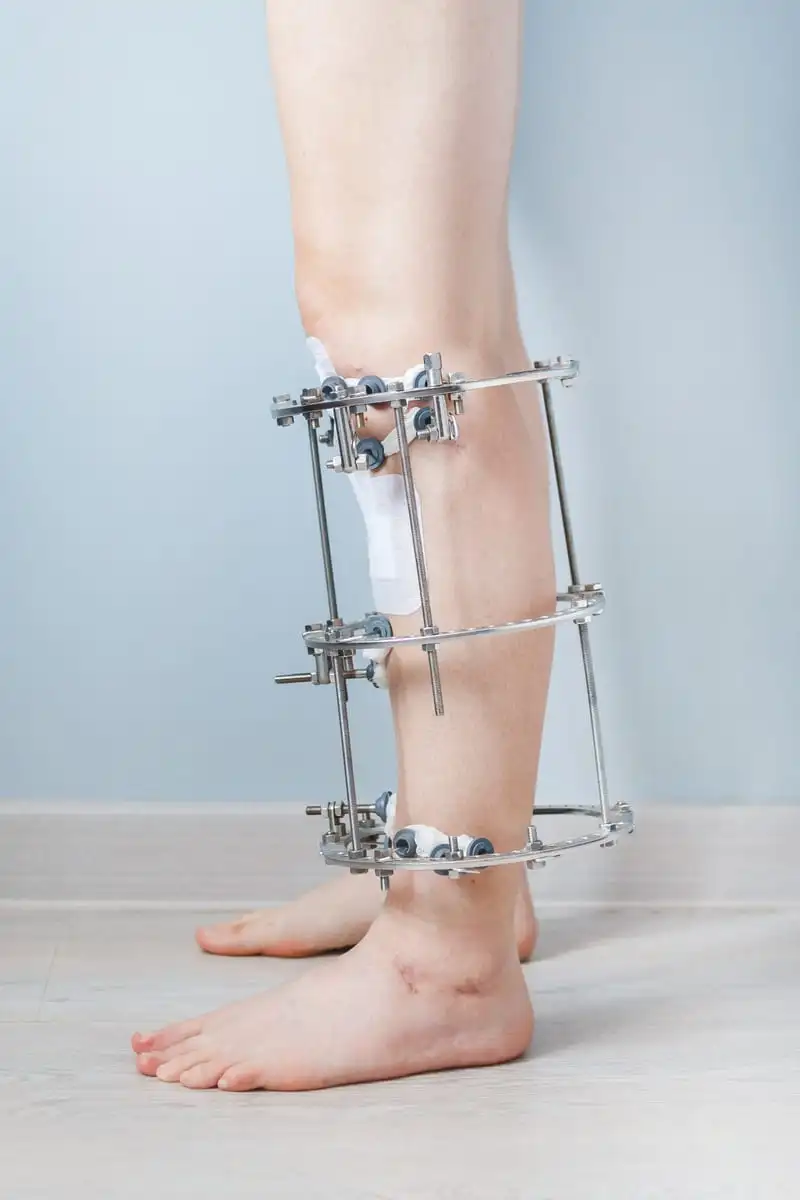
- A circular frame is attached to the limb with wires and pins and adjusted daily to stretch the bone. It is the most established method, versatile for complex deformities and lower in cost, but the frame is visible and needs meticulous care to prevent pin-site infection.
- Internal fixation (PRECICE nail system)
- A telescopic motorised rod is placed entirely inside the bone and lengthened remotely with an external magnet. It leaves no external hardware, carries a lower infection risk and is more comfortable, but it is more expensive and not suited to very large deformities.
- Combined method
- External and internal fixation are used together when a case needs extra stabilisation during lengthening. It offers the benefits of both approaches for complex cases but involves a more complex surgery and longer recovery.
Limb lengthening surgery recovery time
Recovery is a gradual process that rewards patience and full commitment to physiotherapy; your surgeon sets your individual timeline. The general trajectory is:
- 1 weekYou remain in hospital for pain management, antibiotics and the first physiotherapy sessions, using crutches or a wheelchair. Swelling and mild discomfort are common while your team monitors for complications.
- 3-4 weeksThe distraction phase is well underway and the bone begins to regenerate, though it is still fragile. Frequent physiotherapy maintains joint flexibility and muscle strength as the device is adjusted about 1 millimetre per day.
- 3 monthsSubstantial new bone growth means many patients move to a single crutch or cane and begin partial weight-bearing. Regular X-rays monitor bone consolidation.
- 6 monthsThe lengthening phase is usually complete, external fixators (if used) are often removed, and most patients can walk without aids as they rebuild muscle strength and balance.
- 9-12+ monthsThe bone fully consolidates, the device is removed in a minor second procedure, and most patients return to running and high-impact sport once cleared by their surgeon.
Limb lengthening results and success rate
Limb lengthening has an approximate success rate of around 95% when performed by an experienced specialist, and published surveys report that over 90% of patients are satisfied with the outcome. The high figures are attributed to meticulous surgical technique and modern lengthening devices. A decade or two later, results are generally permanent and stable, with the lengthened limb functioning as well as the other and complications such as arthritis remaining uncommon.
Individual outcomes always depend on your anatomy, general health, and how fully you commit to rehabilitation, skipping physiotherapy is the most common cause of a poor functional result. The most reliable indicator for your case is an honest pre-treatment conversation with your partner surgeon, who assesses your suitability and realistic gains before you commit to travel.
How the limb lengthening procedure works, step by step
From first contact to your return home, the process is planned around your case. A typical journey to Istanbul looks like this:
- Consultation. Your surgeon reviews your medical history, goals and X-rays, discusses risks and realistic outcomes, and determines which technique suits you. Cosmetic cases usually include a psychological assessment.
- Medical tests. Blood work, imaging scans and, where indicated, a bone density test confirm you are fit for surgery and rule out conditions that impair healing.
- Surgery and hospital stay. The bone is cut and the lengthening device fitted under general anaesthesia over 2 to 4 hours, followed by a few days in hospital for initial recovery.
- Distraction and rehabilitation. You stay in Istanbul for roughly 8 to 12 weeks while the bone is distracted around 1 millimetre per day, supported by on-site physiotherapy and X-ray monitoring.
- Follow-up at home. You travel home with written protocols and continue daily physiotherapy and monitoring; the device is removed in a minor second surgery 9 to 12 months later.
Ideal candidates and choosing your surgeon
Only the independent partner surgeon you consult with can confirm suitability. In general, healthy adults aged 18 to 55 with closed growth plates, no active infection, well-controlled diabetes, no osteoporosis and good vascular health are typical candidates. Reputable surgeons require a psychological assessment for cosmetic cases to confirm realistic expectations, given the long and demanding recovery. Smoking, heavy drinking and certain medications can impair bone healing.
When choosing a limb lengthening surgeon in Turkey, look for board certification, membership of recognised international orthopedic societies, a specific focus on limb lengthening rather than general orthopedics, and a hospital with JCI or equivalent accreditation. Ask directly about case volume and complication rates. Through Luna, your surgeon credentials, hospital accreditation and the exact implant brand are confirmed in writing before you commit.
Why patients choose Luna Clinic Medical Travel
Verifiable partner surgeons
We only introduce patients to surgeons whose board certification and society memberships can be independently verified.
Clinical decisions stay with your surgeon
Suitability, technique, the procedure and clinical aftercare are handled by your partner surgeon at their own accredited facility.
One coordinator, start to home
A bilingual Luna coordinator handles flight guidance, accommodation, transfers, interpretation and communication with your surgeon.
Transparent, separate quotes
Your surgeon quotes the medical fee; Luna quotes travel coordination separately. You see both side by side, with no hidden costs.
What to expect on your journey
From your first assessment in Istanbul to recovery back home. Clinical steps are carried out by your independent partner surgeon; Luna coordinates the travel around them.
-
Consultation & assessment
Your independent partner surgeon reviews your goals, health and anatomy and confirms whether the treatment is right for you.
-
Personalised treatment plan
Technique, timing and what to expect are planned around your case, with a clear, itemised quote before you travel.
-
Your procedure in Istanbul
Luna coordinates transfers, accommodation and interpretation; your surgeon carries out the treatment at their accredited facility.
-
Recovery & follow-up at home
You return home with a clear recovery plan; Luna keeps you connected to your surgeon for follow-up communication.
Reviewing before-and-after results is an important step when choosing a surgeon. Where available, before-and-after images are sourced from the partner surgeon’s own practice, shown as examples only, and do not guarantee a similar result for your case.
Get a personalised quote
Tell us your goals and we will introduce you to the right independent partner surgeon in Istanbul, then coordinate every step.
- No obligation, free of charge
- Reply from a bilingual patient coordinator
- Clear, itemised quote before you travel
Thank you, your enquiry is on its way.
A bilingual Luna patient coordinator will get back to you shortly. We coordinate your travel; your independent partner surgeon makes every clinical decision.
Frequently Asked Questions
How much does limb lengthening surgery cost in Turkey?
Through Luna Clinic Medical Travel Services, limb lengthening in Istanbul costs from €24,000 to €65,000, coordinated with independent partner surgeons. The price depends on the technique (a PRECICE internal nail is at the higher end, an Ilizarov external frame at the lower end), the bones being lengthened (femurs only versus femurs and tibias), and the length of in-Turkey rehabilitation included. By comparison, equivalent procedures at UK private clinics, where available, typically cost £80,000 to £120,000. Your full quote is fixed in writing before you travel.
How much height can I gain through limb lengthening?
Realistic gains depend on the bone treated. Femur (thigh) lengthening typically adds 5 to 8 cm and tibia (shin) lengthening 4 to 6 cm. Most adult cosmetic patients lengthen the femurs only and gain 5 to 8 cm in a single procedure. Combined femur-and-tibia lengthening can theoretically add up to 13 to 15 cm but requires two separate surgeries with full recovery between them and carries significantly higher risk. Your surgeon confirms what is realistic for your case.
Is limb lengthening surgery in Turkey safe, and who performs it?
Limb lengthening in Turkey is safe when performed by a board-certified orthopedic surgeon who specialises specifically in limb lengthening, not a general orthopedic surgeon, at a hospital with full surgical and rehabilitation facilities. This is major surgery, and surgeon experience is the single most important safety factor. Luna only introduces patients to independent partner surgeons whose credentials, hospital accreditation and case volume are confirmed in writing before you commit to travel.
What is the difference between Ilizarov, PRECICE and combined techniques?
The Ilizarov method uses an external circular frame attached with pins through the skin: the most established technique, lower cost and suitable for complex deformities, but visible and harder to keep clean. PRECICE is an internal motorised nail placed entirely inside the bone and lengthened by an external magnet: less visible, lower infection risk and more comfortable, but more expensive. Combined approaches use both for cases needing extra stability.
How long do I need to stay in Turkey for limb lengthening?
You will need to stay in Turkey for around 8 to 12 weeks after surgery to complete the bone-distraction phase under direct medical supervision and on-site physiotherapy. After that you can travel home with the device still in place and attend virtual follow-ups. The lengthening device is removed in a minor second surgery 9 to 12 months later, which can be arranged in Istanbul or with a local orthopedic surgeon at home.
Is limb lengthening painful, and what is recovery like?
The surgery is performed under general anaesthesia. The lengthening phase that follows, during which the bone is distracted 1 mm per day for one to three months, causes a dull ache and muscle tightness that is significant but managed with painkillers and physiotherapy. The most uncomfortable period is usually weeks 2 to 6. By month 3 most patients use only one crutch, unaided walking returns at 6 to 9 months, and running and sport at 9 to 12+ months.
Are non-surgical methods effective for increasing height?
No. After the growth plates close in your late teens, no exercise, supplement, stretching device or pill can lengthen your bones. Marketed height-increase supplements, hormone treatments for closed-plate adults, decompression devices and grow-taller programmes have no scientific evidence of producing real height gain. Insoles and shoe lifts add visible height of 2 to 7 cm without surgery, a low-cost, non-invasive alternative if you do not want surgery.
What does Luna help arrange for a limb lengthening trip?
Luna coordinates the travel side: flight guidance, accommodation for the 8 to 12 week stay, airport and in-city transfers, interpretation, and ongoing communication with your independent partner surgeon before, during and after your visit. The surgical fee, device, tests, hospital stay and clinical aftercare are arranged and quoted directly by your surgeon. We present both quotes together, and your surgeon credentials and implant brand are confirmed in writing before you book.
Partner surgeons for this treatment
Independent partner surgeons in Istanbul whom international patients see for this procedure. Luna Clinic Medical Travel Services coordinates your travel while your surgeon makes every clinical decision.
