Norwood Scale: The 7 Stages of Hair Loss and How Many Grafts Each May Need

On this page
What is the Norwood scale?
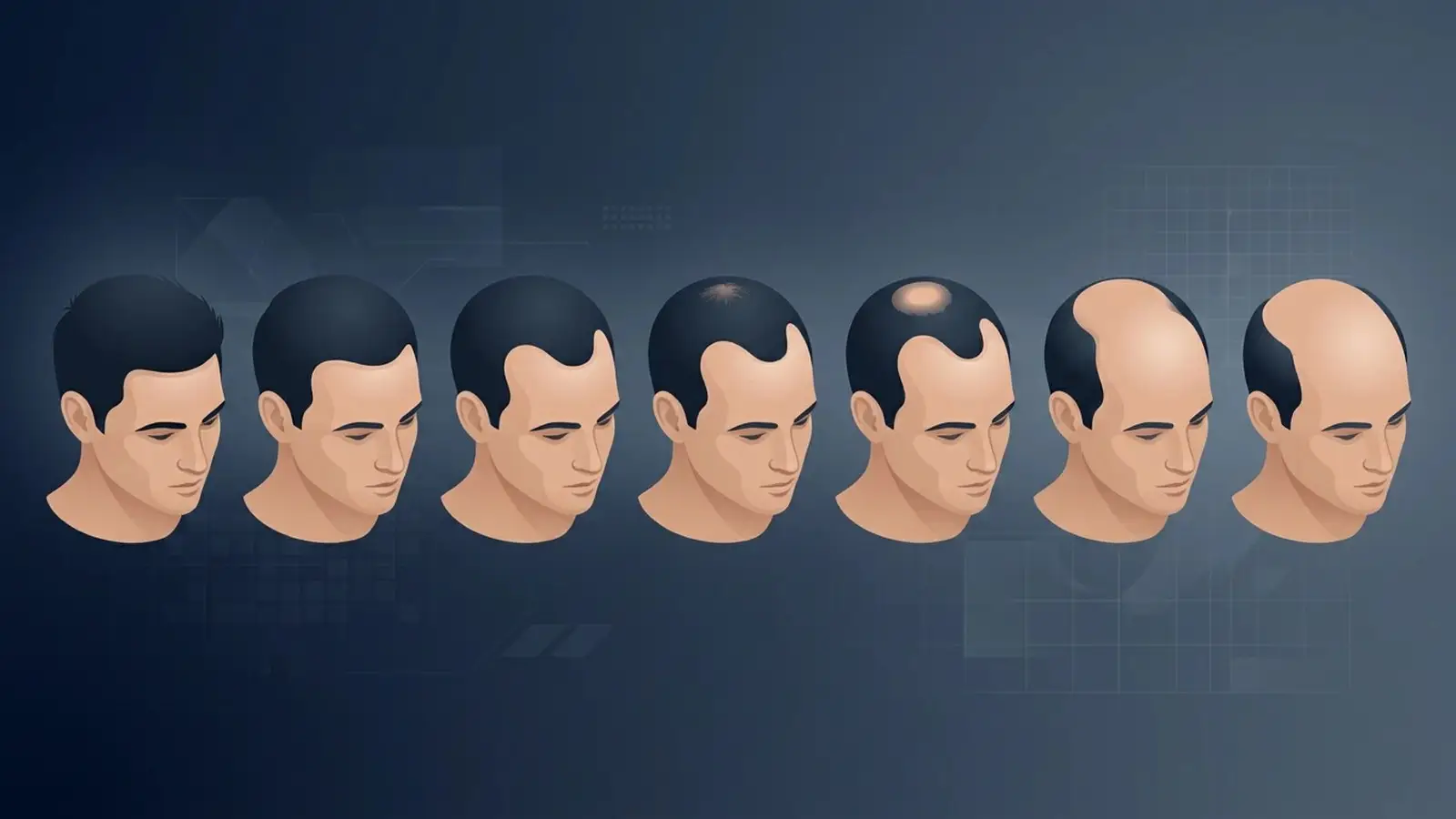
The Norwood scale is a system for describing male pattern hair loss. James Hamilton published the original classification in 1951, and O'Tar Norwood revised it in 1975, which is why it is also called the Hamilton-Norwood scale.
It groups hair loss by the shape and extent of the balding pattern, from no visible loss at stage 1 to only a band of hair around the sides and back at stage 7. Doctors use it to describe where you are now. It does not predict how fast you will lose hair or how far your hair loss will go.
The 7 stages of the Norwood scale
| Stage | What it looks like |
|---|---|
| Stage 1 | No significant hair loss or hairline recession. |
| Stage 2 | Slight recession around the temples, sometimes called a mature hairline. |
| Stage 3 | The first clinically significant balding, with deep temple recession in an M, U or V shape. |
| Stage 3 vertex | The hairline stays near stage 2, with significant hair loss on the crown. |
| Stage 4 | Deeper recession at the front and sparse or no hair on the crown, with a band of hair between them. |
| Stage 5 | Both bald areas are larger, and the band between them is narrower and thinner. |
| Stage 6 | The front and crown areas join, and the band across the top is gone or sparse. |
| Stage 7 | The most advanced stage. Only a band of hair remains around the sides and back, and it may be fine. |
Some men follow a less common Class A pattern, where the hairline moves back evenly with no separate bald area on the crown.
How do you work out your Norwood stage?
Take clear photos from the front, from both sides and from above, in good light with your hair dry. Compare them with the table above. Look at your temples, your crown and whether there is still a band of hair between them.
A photo comparison gives you a rough idea only. Thinning can be hard to judge, and hair loss has other causes. If your hair loss is sudden, patchy or comes with an itchy or sore scalp, see a doctor. The stage is also not the same as a diagnosis, so ask a qualified doctor to confirm the cause.
How many grafts might each Norwood stage need?
A graft is a small natural group of hairs, usually one to four. A typical procedure moves 2,000 to 4,000 grafts, but your number depends on your own hair loss. These figures are a rough guide only. They are not a quote or a treatment plan.
| Stage | Area usually treated | Rough graft guide |
|---|---|---|
| Stage 1 | None | Usually no transplant needed |
| Stage 2 | Temples, if treated at all | Often no transplant needed |
| Stage 3 | Hairline and temples | About 1,500 to 2,500 |
| Stage 3 vertex | Crown | Depends on the size of the crown |
| Stage 4 | Hairline, mid-scalp and crown | About 2,500 to 4,000 |
| Stage 5 | Larger front and crown areas | 2,500 to 4,000 or more, and possibly more than one session |
| Stage 6 | Most of the top of the scalp | More than one session may be needed, and full coverage may not be possible |
| Stage 7 | Most of the top and crown | Limited by donor hair, and full coverage is unlikely |
More is not better. Your surgeon must arrive at the number after examining you. Treat any offer of unlimited grafts, or a high fixed count quoted without an assessment, as a warning sign.
What else affects your graft count?
- Donor area: the density and quality of hair at the back and sides decide how many grafts can be safely taken.
- Density goal: a thicker result needs more grafts over the same area.
- Hair type: thickness, colour and curl can change how much coverage each graft gives.
- Your age and future loss: a younger man may keep losing hair, so your surgeon must keep grafts in reserve.
- Previous surgery: an earlier transplant can reduce the donor hair available.
Is a hair transplant right at every Norwood stage?
No. A hair transplant moves hair from one place to another. It does not create new hair, and it does not stop your existing hair loss.
Early stages: if you are at stage 1 or 2, a transplant is often unnecessary. If you are young and your hair loss is still changing, a surgeon may advise waiting, because transplanted hair can look uneven if the hair around it recedes later.
Middle stages: men at stages 3 to 5 with stable hair loss and a strong donor area can be good candidates, depending on a surgeon's assessment.
Advanced stages: a transplant is not automatically ruled out at stages 6 and 7, but your donor area may not cover the whole bald area. A surgeon may prioritise the front of the scalp, and you should expect a lower density than a full head of hair.
Only a surgeon who has assessed your scalp can tell you whether surgery suits you.
Why stabilising hair loss comes first
The NHS describes finasteride and minoxidil as the main treatments for male pattern baldness. It also says they do not work for everyone and only work for as long as you use them, and that not all treatments are available on the NHS.
Treatment tends to work best when started early, so talk to a doctor as soon as you notice a change. A surgeon may also recommend medication before or after a transplant to protect your existing hair. Any prescription is a medical decision for a qualified doctor, because side effects and suitability vary. Finasteride is generally not recommended for women, especially anyone who could become pregnant.
What results can you realistically expect?
The transplanted hairs usually fall out in the first few weeks, which is normal and does not mean the procedure has failed. New growth usually starts at around three to four months, thickens by six to nine months and reaches close to its final look at about twelve months or later.
Transplanted hair generally keeps growing, because follicles from the donor area resist the hormone that drives pattern hair loss. Your other hair can keep thinning, though, so some people need more treatment later. No surgeon can promise a specific density or guarantee that every graft will survive.
What about hair loss in women?
The Norwood scale describes male pattern hair loss. Women usually lose hair differently, with thinning across the top of the head, so it is not the right tool for them. Our guide to hair transplants for women explains the options.
Read more about a hair transplant in Turkey.
Luna Clinic Medical Travel Services is a medical travel coordinator, not a clinic. Luna does not perform surgery or guarantee a medical result. Every clinical decision is made by your independent partner surgeon.
Sources & references
- Hamilton JB. Patterned loss of hair in man: types and incidence. Annals of the New York Academy of Sciences, 1951;53(3):708-728
- Norwood OT. Male pattern baldness: classification and incidence. Southern Medical Journal, 1975;68(11):1359-1365
- Healthline: Norwood scale
- NHS: Hair loss, reviewed 24 January 2024
- International Society of Hair Restoration Surgery

Kubilay Aydeğer leads and reviews Luna Clinic Medical Travel’s patient content, pairing senior medical-writing and digital-marketing experience with a doctor-reviewed process so people planning treatment abroad get clear, accurate guidance.

Plastic, Reconstructive & Aesthetic Surgery Specialist · Istanbul
Last reviewed
Indicative only. Your surgeon confirms suitability, technique and price after consultation. No outcome is guaranteed.
Frequently Asked Questions
What is the Norwood scale?
It is a system that classifies male pattern hair loss from stage 1, with no significant loss, to stage 7, the most advanced stage. It is also called the Hamilton-Norwood scale.
Is Norwood 2 balding?
Stage 2 is a slight recession around the temples, and it is sometimes called a mature hairline. It may not progress much further, so ask a doctor if you are concerned.
At what Norwood stage should you get a hair transplant?
There is no single right stage. It depends on your age, how stable your hair loss is and the strength of your donor area. A surgeon can advise after assessing you.
Is Norwood 7 too late for a hair transplant?
Not always, but full coverage is unlikely. Your surgeon assesses whether your donor area can give a worthwhile result, and may focus on the front of the scalp.
How many grafts do I need for a hair transplant?
It depends on the area, your density goal and your donor supply. As a rough guide, a receding hairline might need 1,500 to 2,500 grafts, and the mid-scalp and crown together often need 2,500 to 4,000.
Can you stop hair loss at Norwood 2 or 3?
Treatments such as finasteride and minoxidil may help some men, but they do not work for everyone and only work for as long as you use them. Ask a doctor what suits you.
Get a free, no-obligation quote
Tell us your goals and we will introduce you to the right independent partner surgeon in Istanbul, then coordinate every step.