Loose Skin After Weight Loss: What Helps Without Surgery, and When Surgery Is the Answer

On this page
Losing a large amount of weight is supposed to feel like an ending. For a lot of people it is the point at which a new problem starts: the weight has gone, and the skin that used to hold it has not.
This guide explains what loose skin after weight loss actually is, what the non-surgical advice can and cannot do, when surgery becomes the only real option, and what that costs in the UK compared with treatment abroad. It is general information written to help you have a better conversation with a surgeon. It is not a substitute for an individual assessment.
What Loose Skin Actually Is
Skin is not a passive bag. It is a living organ with two proteins doing most of the mechanical work: collagen, which gives it strength, and elastin, which lets it stretch and recoil. When the body expands, the skin expands with it. If it stays expanded for years, the elastic fibres are held under constant tension and progressively lose their recoil.
Take the volume away quickly and you are left with a skin envelope sized for a body that no longer exists. Some of it retracts. The part that has lost its elasticity does not. That is why loose skin is not a sign that you did something wrong: it is the predictable result of how long and how far the skin was stretched.
Loose skin versus remaining fat
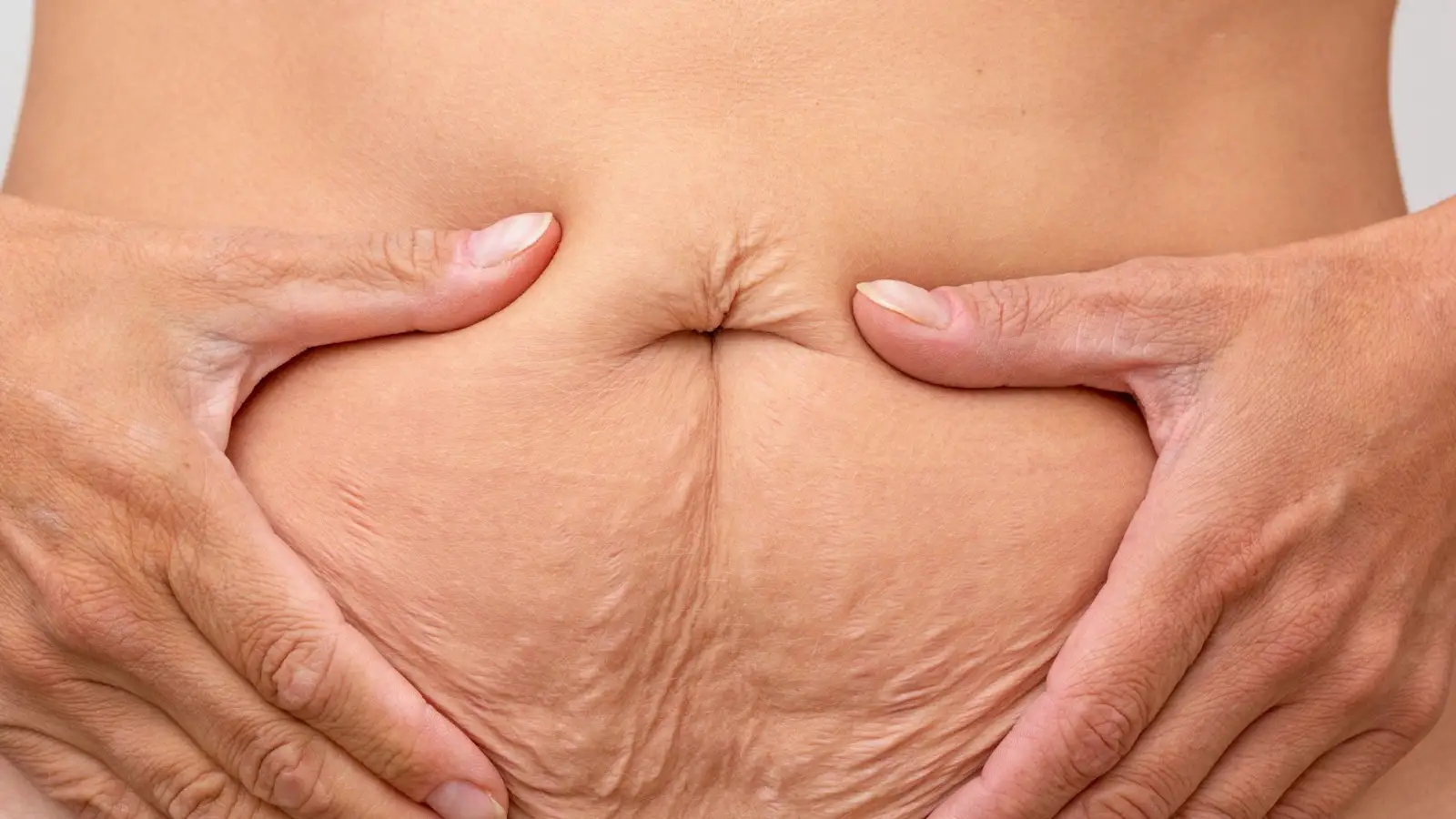
These get confused constantly, and they need completely different answers. A simple way to tell them apart is to pinch the area while relaxed. If what you gather between your fingers is thin, soft and moves like fabric, that is skin. If it is thick and firm, there is still fat underneath, and further weight loss or liposuction can change it. Most people after major weight loss have some of both, which is why surgeons assess the two separately.
How Much Weight Loss Causes Loose Skin?
There is no number that applies to everyone, and any article that gives you one is guessing. What is well established is the list of things that make it more likely:
- How much you lost. Larger losses stretch and then empty a larger skin envelope.
- How fast you lost it. Slower loss gives skin more time to adapt.
- How long you carried the weight. Years of sustained stretch do more damage to elastic fibres than a recent gain.
- Your age. Collagen and elastin production falls with age, so skin recoils less well at 50 than at 25.
- Smoking and sun damage. Both degrade the elastic network directly.
- Genetics. The part nobody can control, and often the reason two people with identical weight loss get different results.
Pregnancy adds another mechanism: the abdominal muscles can separate, which is a muscle problem rather than a skin one and needs a different repair. That is covered on our mommy makeover page.
Does weight loss medication change this?
The skin behaves the same way, but the circumstances are different. GLP-1 medication can produce large losses quickly, which is exactly the pattern that leaves skin behind. Some of the weight lost is muscle as well as fat, and less muscle under the same skin envelope makes the area look emptier and more deflated. If you are losing weight on medication, resistance training and adequate protein are not optional extras. They are the part of the plan that changes how the result looks.
What Genuinely Helps Without Surgery
These measures are worth doing. Just be clear about what they do: they improve what sits underneath the skin, and they may help mild laxity settle. None of them removes a skin fold.
- Strength training. Building muscle in the arms, chest, thighs and back partially refills the envelope. It is the single most useful thing most people can do, and it is what makes the difference between deflated and toned in mild cases.
- Enough protein. Protein preserves muscle during a calorie deficit and supplies the raw material for collagen. Losing weight on a low protein intake costs you muscle you will miss later.
- A slower rate of loss, where that is realistic. Not always in your control, especially after bariatric surgery, but where it is, it helps.
- Stopping smoking and protecting skin from the sun. Both preserve the elastic network you still have.
- Time. Skin continues to retract for a while after weight stabilises. Judging your final result at three months is judging it too early.
What does not work
Firming creams, body wraps, collagen drinks and vigorous massage are marketed heavily at exactly this moment, when people are motivated and disappointed. None of them has been shown to remove established excess skin. Non-surgical tightening devices using radiofrequency or ultrasound can produce modest changes in skin quality in mild cases, and they are sometimes worth discussing, but they do not deal with a hanging fold. If a treatment promises to remove one without surgery, that promise is the problem.
When Surgery Is the Only Option
Surgery becomes the realistic answer when the skin is causing problems that are physical rather than aesthetic, or when the appearance is affecting daily life and nothing else will change it. Common signs that you have crossed into surgical territory:
- A fold of skin that hangs over the waistband, sometimes called an apron or pannus.
- Recurrent rashes, chafing or fungal infections in the fold that keep coming back despite treatment.
- Difficulty with clothing, hygiene, exercise or movement because of the skin itself.
- Skin on the upper arms or inner thighs that hangs loosely and rubs when you walk.
Body contouring after major weight loss is not one operation. It is a set of them, and most people need more than one area addressed:
- Apronectomy or panniculectomy: removes the overhanging apron of lower abdominal skin. It does not tighten the muscle or reposition the navel.
- Abdominoplasty (tummy tuck): removes excess skin and, where needed, repairs separated abdominal muscle.
- Arm lift (brachioplasty): removes loose skin from the upper arm, leaving a scar along the inner arm.
- Thigh lift: addresses inner thigh skin that chafes and interferes with walking.
- Breast lift: repositions breast tissue that has lost volume and support.
Every one of these trades a fold for a scar. That is the honest bargain, and a good surgeon will spend as much time on where the scars will sit as on what is being removed.
Can You Get Skin Removal Surgery on the NHS?
Sometimes, but the criteria are stricter than most people expect, and they are set locally by each Integrated Care Board rather than nationally. The NHS position is that this is cosmetic surgery unless the excess skin is causing significant functional difficulty.
To show what that means in practice, NHS Gloucestershire's commissioning policy funds abdominoplasty or apronectomy for patients who have "achieved a reduced weight of at least 50% and have maintained this weight loss for 12 months and have severe functional problems related to the excess abdominal skin including severe difficulties in daily living i.e. ambulatory restrictions". Patients also have to maintain that weight from the point of being listed until the operation itself. Notably, that policy was revised in November 2024 to reduce the weight-stability requirement from 24 months to 12.
Three practical points that catch people out:
- Your local policy may differ. Criteria and even which operation is funded vary between boards, so check your own ICB rather than a national summary.
- Appearance alone does not qualify. Distress about how the skin looks, without functional problems, is generally outside policy.
- You cannot apply yourself. Exceptional cases go to an Individual Funding Request panel, and the Gloucestershire policy states plainly that personal applications from patients cannot be considered. It has to come from your GP, consultant or clinician.
This is why so much of the demand ends up in the private sector, and why the price difference between countries matters so much to people who have already spent years and money getting the weight off.
What Skin Removal Surgery Costs
Private UK prices and the equivalent all-inclusive package price through Luna, coordinated with independent partner surgeons in Istanbul. Package figures are starting prices; your surgeon sets the final quote after assessing you, because the amount of skin, the number of areas and the complexity all change it.
| Procedure | Typical UK private cost | Turkey, from |
|---|---|---|
| Abdominoplasty (tummy tuck) | £8,000 to £12,000 | €3,150 |
| Arm lift | £4,500 to £8,000 | €2,400 |
| Thigh lift | £6,000 to £10,000 | €2,500 |
| Breast lift | £5,000 to £7,000 | €2,800 |
| Combined procedures (mommy makeover) | £12,000 to £20,000 | €5,000 |
The gap is real, but it is not the only thing to weigh. Combining areas in one operation costs less than doing them separately and means one recovery, yet it also means longer anaesthesia and a bigger physical demand. Which combinations are safe for you in a single session is a clinical decision, not a shopping decision, and a surgeon who agrees to everything at once without assessing you is telling you something about how they work.
Timing: Do Not Operate Into a Moving Target
Body contouring works best on a body that has stopped changing. Surgeons generally want your weight stable, commonly for around a year, for two reasons. Losing more weight afterwards loosens the result you paid for. Gaining it back stretches the repair. If you are still on a weight loss medication, still in the active losing phase after bariatric surgery, or planning weight loss surgery in the near future, that sequence comes first and contouring comes after.
Nutrition matters here too. People who have had bariatric surgery can be low in protein, iron, vitamin D and B12, and healing a long surgical wound depends on those levels being adequate. Blood tests before contouring surgery are not a formality.
How Luna Coordinates This
Luna Clinic Medical Travel Services is a medical travel coordination company, not a clinic. We do not perform surgery and we do not make clinical decisions. What we do is connect you with an independent, board-certified partner surgeon in Istanbul, pass on your photographs and history so the assessment is done properly before you fly, and then organise the practical side: accommodation, transfers, interpretation and communication with the surgeon's team while you are here and after you go home.
Who is a suitable candidate, which areas can safely be combined, and what the result will look like are the surgeon's judgements, made in their own accredited hospital. If you want to start, send photographs and your weight history through the free quote form and we will arrange an assessment with the right partner surgeon.
Sources & references

Sedef Özdemir writes Luna Clinic Medical Travel’s patient guides, translating what independent partner surgeons do into clear, honest information for people planning treatment abroad.

Plastic, Reconstructive & Aesthetic Surgery Specialist · Istanbul
Last reviewed
Indicative only. Your surgeon confirms suitability, technique and price after consultation. No outcome is guaranteed.
Frequently Asked Questions
How much weight loss causes loose skin?
There is no threshold that applies to everyone. The risk rises with the total amount lost, how quickly it came off, how many years you carried the extra weight, your age, whether you smoke and your genetics. Two people can lose the same amount and end up with completely different skin.
Will loose skin tighten on its own?
Some of it can. Skin has a limited ability to retract, and mild laxity often improves over roughly 12 to 24 months as the body settles. Skin that hangs in a fold, that you can lift away from the muscle, and that has lost its elastic recoil will not shrink back no matter how long you wait.
How do you get rid of loose skin after weight loss without surgery?
You cannot remove established excess skin without surgery. What you can do is change what sits under it: strength training and adequate protein preserve muscle so the area looks fuller and firmer, and losing the remaining weight slowly gives skin more time to adapt. Creams, wraps, collagen supplements and massage do not remove a skin fold.
Can I get excess skin removal surgery free on the NHS?
Sometimes, but the bar is high and it is set locally by each Integrated Care Board. A typical policy funds surgery only when you have lost at least half your excess weight, kept that loss for 12 months and have severe functional problems such as restricted movement or recurrent skin infections. Cosmetic dissatisfaction alone is not funded, and requests outside policy have to be submitted by your GP or consultant, not by you.
How much does loose skin surgery cost?
In the UK an abdominoplasty routinely costs £8,000 to £12,000 privately, and arm or thigh surgery several thousand pounds each. Through Luna Clinic Medical Travel Services, an abdominoplasty with an independent partner surgeon in Istanbul starts from €3,150 all inclusive, an arm lift from €2,400 and a thigh lift from €2,500. Your surgeon gives the final quote after assessing you.
When should I have skin removal surgery after weight loss?
Surgeons generally want your weight to be stable first, commonly for around a year, because losing more afterwards can loosen the result and gaining it back can undo it. If you are still planning bariatric surgery or still losing on medication, body contouring waits until that phase is finished.
Does loose skin from weight loss injections behave differently?
The skin itself behaves the same way. What differs is the pace. Rapid loss on GLP-1 medication gives skin less time to adapt, and some of the loss can come from muscle as well as fat, which makes the same skin envelope look emptier. Resistance training and enough protein matter more, not less, on these medications.
Get a free, no-obligation quote
Tell us your goals and we will introduce you to the right independent partner surgeon in Istanbul, then coordinate every step.